Using WhatsApp in plemeo.ai
Once your WhatsApp number is connected — either via Quick Connect or the advanced manual flow — a WhatsApp entry appears in the side navigation. This page explains how to send and receive messages, draft AI replies, attach context files, and start new conversations from there.
Layout overview
The WhatsApp page is split into three working areas:
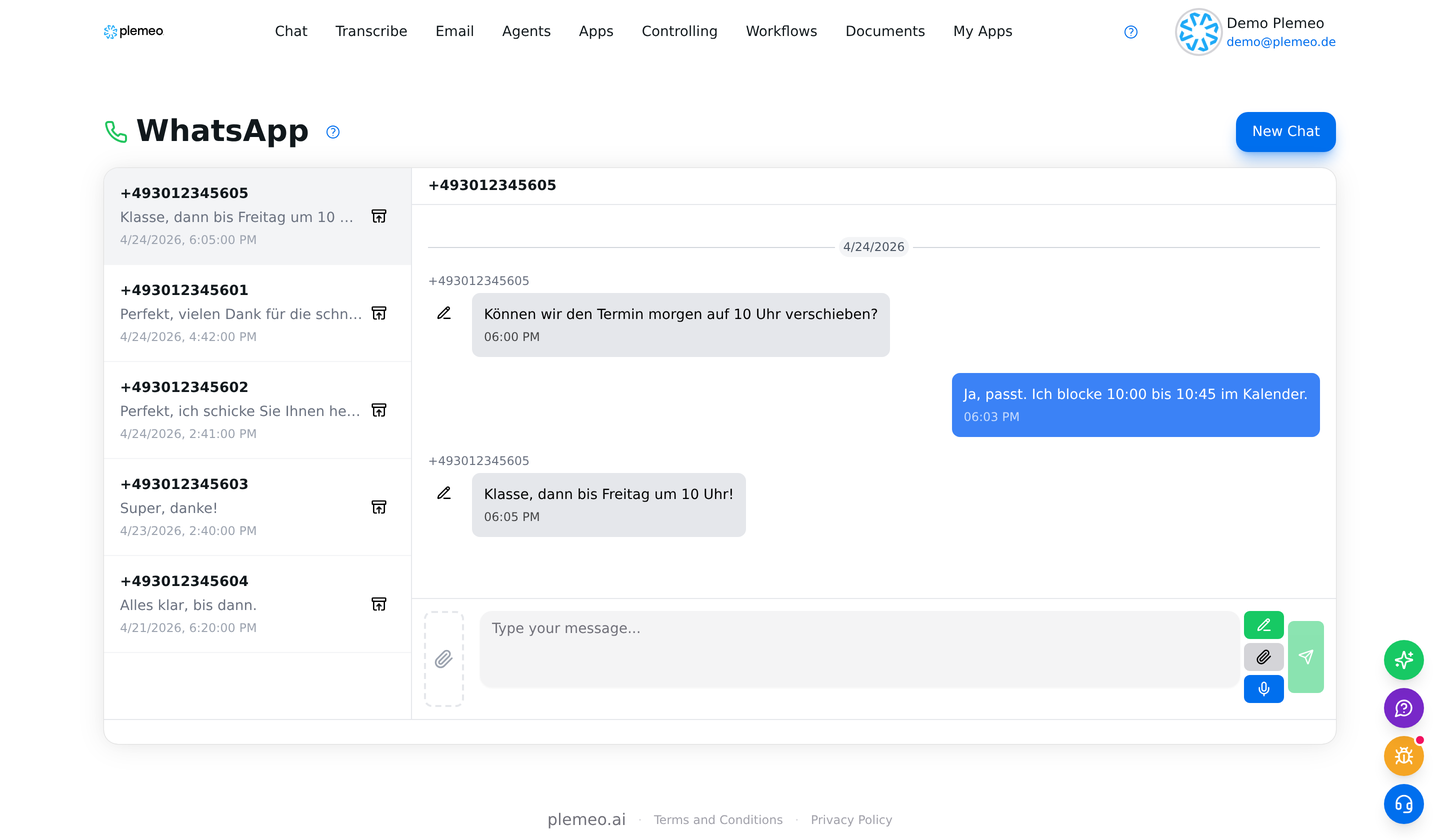
| Area | What it does |
|---|---|
| Conversation list (left) | All chats you can see for the connected number, sorted by latest message. Each row shows the customer's number, a preview of the last message, and a timestamp. Use the archive icon to hide a conversation; reopen it any time via New Chat with the same number. |
| Chat area (right) | The selected conversation. Inbound and outbound messages are bubbled, grouped by date. AI-drafted replies appear inline on the outbound side with Regenerate, Edit, and Send controls. |
| Composer (bottom) | The message editor. Has buttons to draft an AI reply, attach a WhatsApp file, dictate via the voice assistant, and a large Send button on the right. The dotted area on the left lets you attach context files for the AI (not sent to WhatsApp). |
A help icon next to the page title launches a guided tour that walks new users through these areas.
Reading messages
- Click a row in the conversation list to open it on the right.
- New inbound messages arrive automatically — the page polls every couple of seconds while it's visible (polling pauses when you switch tabs).
- Each message bubble shows the time. Inbound messages also display the sender phone number above the bubble.
- Inbound documents and images render inline; for documents you'll see a download link and — for files you want to keep — a Save button that uploads the file into your plemeo.ai documents.
Sending a regular message
- Click into the conversation.
- Type into the composer at the bottom and click the green Send button (or hit
Enterafter clicking inside the textarea). - Optionally attach a file via the paperclip button next to Send. WhatsApp Cloud API supports common document and image types (PDF, DOCX, XLSX, PPTX, PNG, JPG, GIF). The file is uploaded to Meta first; the spinner shows progress.
- The new message appears immediately in the chat (optimistic update) and turns into the official message once Meta acknowledges it.
24-hour rule
WhatsApp lets you send free-form messages only within 24 hours of the customer's last reply. After that, the composer locks and you must use a pre-approved template — see Sending outside the 24-hour window below.
Drafting an AI reply
There are two places to generate an AI reply for the active conversation:
- Pencil icon next to an inbound message — generates a contextual reply for that specific message. The draft appears as an outbound bubble with three controls:
- Regenerate — try again with the same prompt.
- Edit — copy the draft into the composer so you can tweak it.
- Send — send the draft as-is.
- Pencil button in the composer toolbar — generates a reply based on whatever is currently in the textarea, plus the conversation's context files.
The draft uses your organization's active AI model. Any context files you attached for this conversation (see below) are included as references in the prompt.
Attaching context files for the AI (not sent to WhatsApp)
The dotted upload area on the left of the composer is different from the paperclip on the right. Files you drop here are:
- Stored only as AI context for the active conversation.
- Never sent to the customer. They simply give the AI more material to draw from when drafting replies.
Use the trash / X icon next to a context file to remove it. Allowed types: .txt, .pdf, .doc, .docx, .xls, .xlsx, .pptx.
Voice input
The microphone button in the composer toolbar starts and stops audio recording. When you stop, plemeo.ai transcribes the audio and inserts the result into the textarea so you can review and send it. Browser permission for the microphone is required.
Starting a new conversation
- Click New Chat in the top-right corner.
- Enter the customer's phone number with country code, with no spaces (e.g.
491234567890). - Click Start Chat.
If a conversation with that number already exists (including hidden / archived ones), plemeo.ai unhides and opens it. Otherwise an empty conversation is created.
Outside the 24-hour window
A brand-new outbound conversation is by definition outside the 24-hour window, so the composer immediately switches to template mode (see below). You can't send a free-form message until the customer replies to your template.
Sending outside the 24-hour window — message templates
Whenever the last activity in the chat is older than 24 hours, the composer shows a yellow notice ("You can only send approved templates") and a Select Template dropdown.
- Pick one of your approved templates from the dropdown.
- Fill in the variable inputs (
1,2, …) that appear below. - Click the green Send button.
The template is sent in the language defined when you created it. After the customer replies, the 24-hour window reopens and the regular composer comes back automatically.
See Message templates for how to create and submit new templates.
Hiding (archiving) a conversation
Click the archive icon at the right of a conversation row to hide it from the list. Hidden conversations are not deleted — you can bring them back by starting a New Chat with the same number, which automatically unhides and selects the conversation.
Troubleshooting
| Symptom | Likely cause | What to do |
|---|---|---|
| Page says "WhatsApp is not configured" with a Configure WhatsApp button | Your user has no active WhatsApp config | Click Configure WhatsApp to open the Apps modal and connect a number — see Quick Connect. |
| Composer is locked and shows a yellow template notice | Last message in the chat is older than 24 hours | Send a template message — once the customer replies, the regular composer comes back. |
| "Failed to send message" on Send | Often a recipient-side issue (number not on WhatsApp, blocked you, network) or expired access token (manual flow only) | Retry. If it persists, check the WABA in Meta Business Manager and your tokens. For Quick Connect users this usually resolves by a quick disconnect / reconnect. |
| AI Reply button is disabled | A reply is already being generated, an audio is being transcribed, or your org has no active AI model | Wait for the spinner to finish, or set an active AI model in Settings → AI Models. |
| Microphone button does nothing | Browser blocked microphone access for the site | Allow microphone access in the browser site settings and reload. |
| Inbound document Save button doesn't appear | The message is outbound, or the document hasn't fully downloaded yet | Wait for the download to finish; Save is only shown for inbound documents you want to add to plemeo.ai. |
What's next?
- Message templates — create and manage approved templates.
- Quick Connect — connect another phone number.
- Back to overview — WhatsApp setup overview.